Why are your ground improvement projects barely profitable after cost accounting? It all boils down to the wrong methods and equipment. Vibroflotation delivers fast, cost-effective deep soil treatment.
If you’re unfamiliar with the vibroflotation method or vibroflot equipment, this guide breaks it down clearly and teaches you to choose the right units for higher project profits.
What is Vibroflotation?
Vibroflotation is a field-proven deep ground improvement technique. Using high-magnitude horizontal vibration and water/air jetting, a vibroflot penetrates deep subsoil to reinforce the ground. It primarily splits into two methods:
- Vibro-Compaction: Best for loose, granular soils (clay content < 10%). It uses direct horizontal vibration to fluidize and densify in-situ sandy soils, eliminating seismic liquefaction risks.
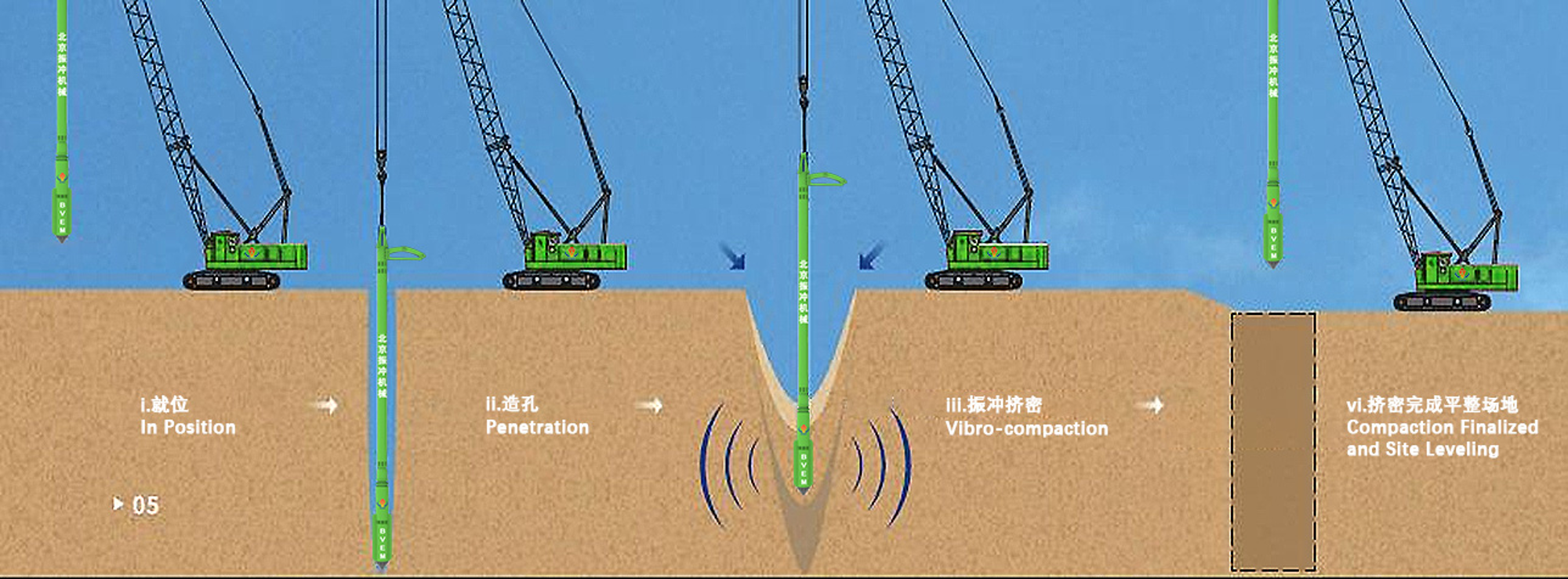
- Vibro-Replacement (Vibro Stone Columns): Ideal for cohesive, silty, or mucky soils where direct compaction fails. It creates boreholes and backfills crushed stone layer-by-layer to build dense, highly permeable stone columns.
How does vibroflotation work?
Vibro Compaction Process
Used primarily for loose sand and reclaimed soil to densify native soil directly without adding coarse aggregates.
- Positioning & Alignment: Lower the vibroflot to align precisely with the target point and verify probe verticality.
- Vibro-Boring: Activate the vibroflot and high-pressure water system (or compressed air in dry sites). Combined horizontal vibration and jetting fluidize the soil, allowing the probe to penetrate smoothly down to the design depth.
- Borehole Clearing: Reciprocate the probe up and down to flush out loose sediment and trim the hole wall, securing a uniform bore diameter throughout.
- Step-by-Step In-Situ Densification: Lift the vibroflot in successive lifts from bottom to top. Backfill with in-situ sandy soil and apply dwell vibration at each stage to force loose sand particles into a dense, tight matrix. Compaction quality is confirmed when operational parameters (e.g., motor current or hydraulic pressure) hit design thresholds.
- Completion & Relocation: Once compacted up to the design elevation, reposition the equipment to the next point.
Key Takeaway: This process relies purely on rearranging native sand particles to increase density and eliminate liquefaction risks, avoiding expensive material imports.
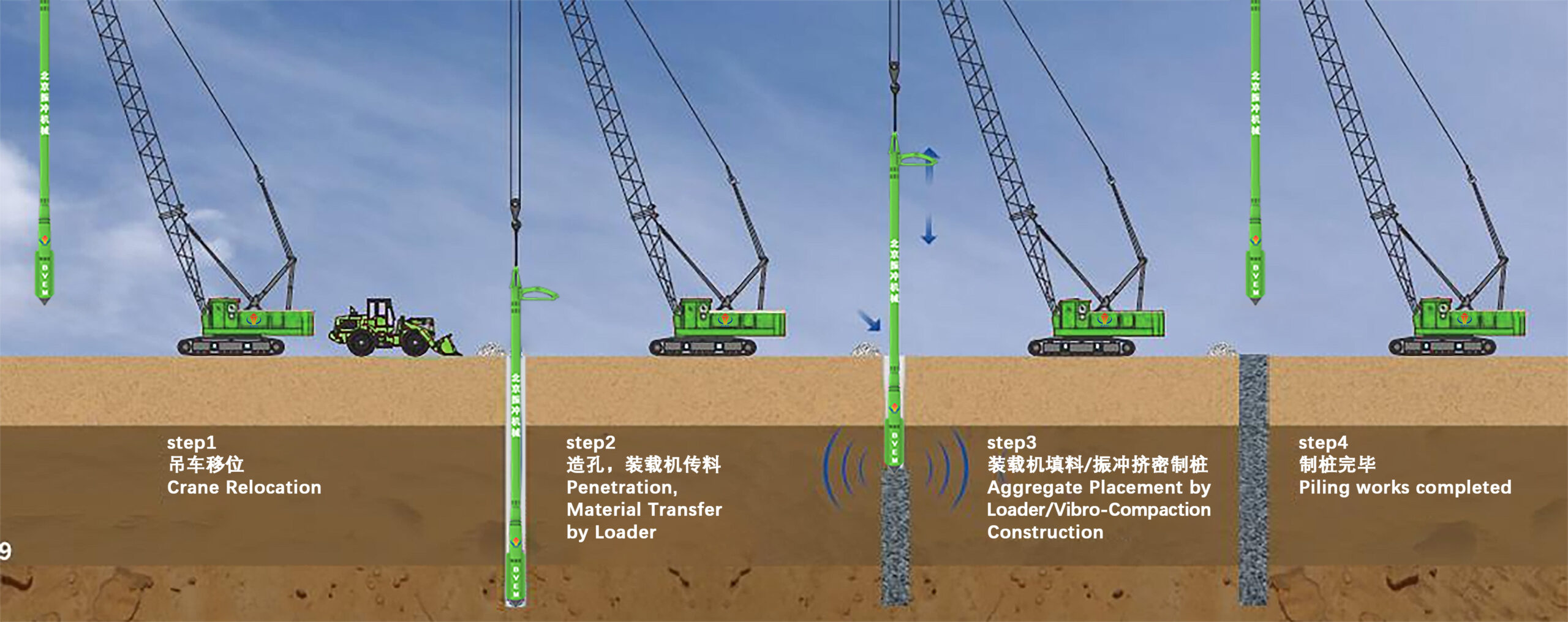
Vibro Replacement Process
Used for soft clays, silts, and weak soils where native soil cannot be compacted directly; relies on imported stone to build structural columns.
- Positioning & Alignment: Position the vibroflot over the designated pile point and calibrate vertical alignment.
- Vibro-Boring: Activate vibration and hydraulic jetting to penetrate soft, weak strata down to the target depth.
- Borehole Stabilization: Cycle the probe up and down to clear loose sediment, flush the borehole, and stabilize the hole wall for aggregate feeding.
- Layer-by-Layer Stone Column Construction: Feed graded crushed stone into the borehole in lifts (via top-feed or bottom-feed system). Apply dwell vibration to compact each stone lift laterally and vertically against the native soft soil, building a continuous, high-stiffness stone column section-by-section.
- Completion & Relocation: Build the stone column up to the design top elevation and relocate the rig to the next position.
Key Takeaway: This process forms a strong composite foundation by interlocking imported rigid stone columns with soft soil, providing both structural support and rapid consolidation drainage.
Engineering Benefits of Vibroflotation
Vibroflotation is engineered to solve four core pain points that commonly plague ground improvement projects, directly reducing costs, shortening schedules and lowering acceptance risks:
Enhanced Liquefaction Resistance
The vibroflot applies powerful high-frequency horizontal vibrations to densify foundation soils, significantly increasing their relative density and shear strength while fundamentally eliminating the conditions that trigger sand liquefaction. At the same time, the constructed stone columns restrain deformation of the surrounding soil, substantially slowing the buildup of excess pore water pressure during seismic events. As a result, the liquefaction resistance of the composite ground is greatly improved, with proven long-term performance in projects located in high-seismic-intensity regions.
Drainage and Pore Pressure Dissipation
The continuous stone columns formed by vibroflotation serve as highly efficient vertical drainage paths, dramatically shortening the seepage distance for pore water. Under seismic loading or additional external loads, excess pore water pressure is rapidly dissipated upward through the stone columns, preventing pressure accumulation that could trigger liquefaction. The system also accelerates soil consolidation and drainage, significantly reducing liquefaction risk under dynamic loading while providing drainage efficiency several times greater than that of untreated sandy soils.
Increased Bearing Capacity
Vibro-compaction simultaneously improves the density and internal friction angle of the in-situ soil. Working together with the stone columns, the surrounding soil forms a high-performance composite foundation. Under applied loads, stresses are preferentially transferred to the higher-stiffness stone columns, while lateral confinement from the columns further enhances the strength of the surrounding soil. As a result, the bearing capacity of the composite foundation typically increases by 50%–200% compared with the natural ground, enabling shallower foundation designs and meeting the ground improvement requirements of medium-rise and high-rise structures.
Mitigation of Differential Settlement
Vibroflotation enables targeted reinforcement of weak interlayers and isolated soft soil lenses according to site-specific geological conditions, producing a more uniform stiffness distribution throughout the improved ground. The enhanced consistency of the composite foundation modulus allows the stone columns and surrounding soil to deform compatibly under loading, effectively minimizing differential settlement caused by variable subsurface conditions and maintaining settlement within allowable engineering limits.
Cushioning Effect
Under structural loading, the upper portions of the stone column group work together with the densified surrounding soil to form a homogeneous load-distribution layer. This layer effectively disperses foundation stresses, reducing peak stress transmitted to the underlying soil. It also promotes a more uniform stress distribution beneath the foundation, mitigates localized stress concentrations caused by uneven loading, and significantly enhances the overall stability of the foundation system. This mechanism is particularly well suited for raft foundations and strip foundations.
Applications of the Vibroflotation Method Across Multiple Sectors
100 m Ultra-Deep Vibro Stone Columns
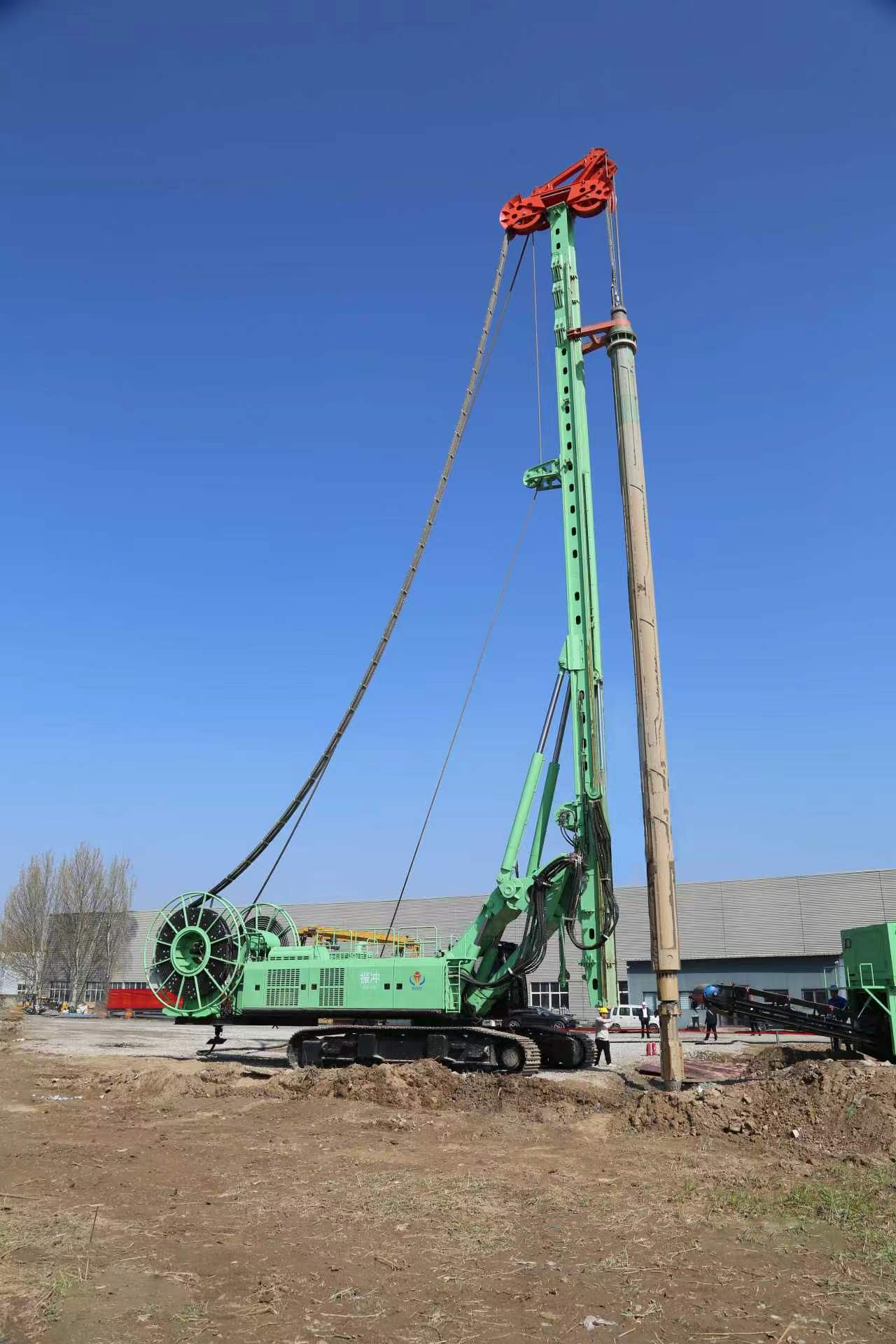
Challenges: Penetrating 100-meter deep cobble and gravel strata is extremely difficult for conventional equipment. High wind conditions make operating giant suspended cranes highly dangerous, while coarse gravel frequently locks and jams the equipment underground—leaving the vibroflot stuck so it can neither penetrate nor withdraw, resulting in catastrophic project downtime.
Solution: Integrated with a standard rotary drilling rig—known as the Vibrocat— our patented full-hydraulic vibroflot utilizes a 40-ton downward crowd force for steady penetration, replaces risky high-crane setups with a stable rig frame, and features a rotary guide rod design that prevents gravel lock and tool seizure. You eliminate equipment jamming risks, ensure smooth up-and-down movement, and achieve reliable 100m deep penetration without costly downtime.
Six-Lifting Vibroflotation Technology
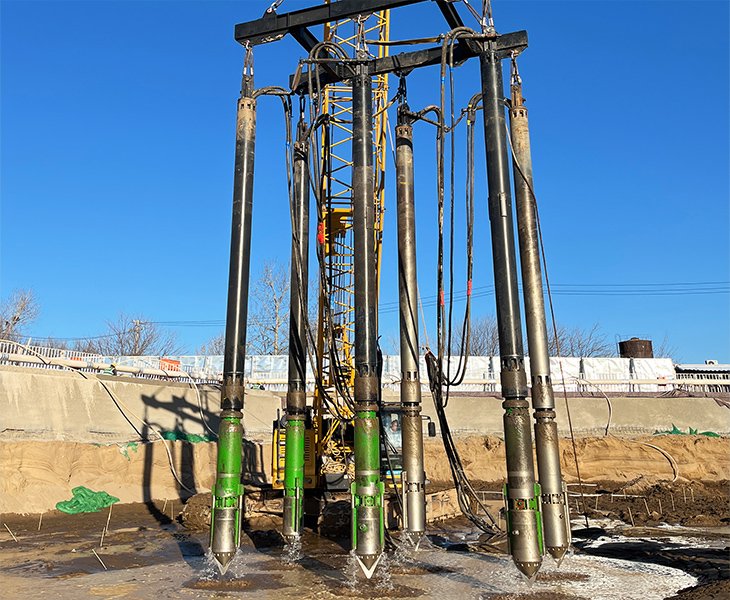
Challenges: Low unit contract prices make it hard to stay profitable without ultra-high daily output. Traditional single or dual-probe setups require large crews, keeping labor costs high and hindering efficiency, while often failing to meet specified soil density requirements—leading to costly re-works.
Solution: Our Six-Lifting system synchronizes six vibroflots in multi-probe resonance, creating a dense grid-like soil confinement that guarantees relative density and eliminates sand liquefaction. Achieving a daily output of up to 2,000 m², it delivers 3x the construction speed of dual-probe systems while significantly reducing labor and energy costs per square meter. You maximize project profit margins under low unit pricing, guarantee high-density compliance, and cut your overall labor overhead.
Dry Vibroflotation Construction Using Hydraulic Vibroflot Mounted on Excavator
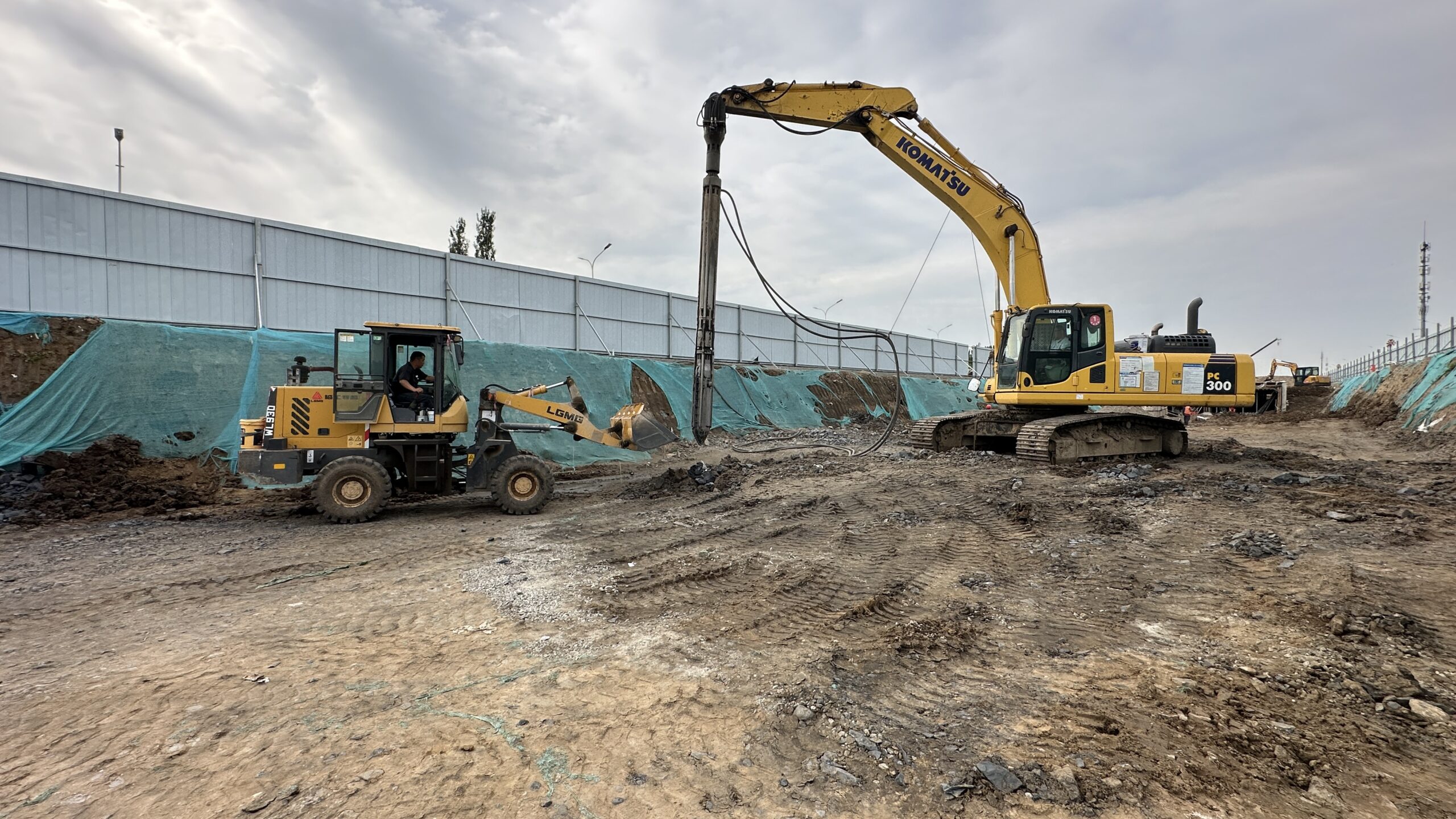
Challenges: Project sites with no water supply make conventional wet vibroflotation completely impossible to execute. Strict green construction mandates require complex slurry treatment systems—like desanders and filter presses—which severely inflate operational costs. Additionally, contractors holding idle excavators are looking for ways to generate income and expand their capabilities into ground improvement.
Solution: By mounting our hydraulic vibroflot directly onto your existing excavator, this water-free dry method uses hydraulic downward force and high-frequency vibration to build dense stone columns with zero slurry generated. You enable construction on waterless sites, eliminate costly slurry equipment, and instantly transform your idle excavators into revenue-generating ground improvement machines.
Cemented Vibro-Replacement Stone Column Assisted Dam Cutoff Wall Construction Technique
Challenges: Trenching deep anti-seepage cutoff walls—typically executed with a diaphragm wall grab—through loose overburden or liquefiable sand layers frequently causes severe trench collapse and hole shrinkage. This forces contractors to rely on expensive heavy slurry support and leads to repeated rework, massive concrete waste, and project delays. Furthermore, conventional standalone cutoff walls address seepage but fail to reinforce weak dam foundations.
Solution: We pre-reinforce the wall alignment by constructing cemented vibro stone columns prior to trenching, compacting in-situ soil to drastically boost shear strength and stabilize loose strata. Your team eliminates trench caving risks during grab operation, slashes heavy slurry costs, avoids expensive rework, and secures a dual-function composite structure that delivers both superior anti-seepage and foundation stabilization.
Ground Improvement of High Water-Content Clay Using Vibroflotation
Challenges: Saturated soft clay has extremely low bearing capacity, unstable long-term settlement, and severe spring-back deformation under compaction. Traditional solutions like over-excavation and soil replacement, natural sun-drying, or lime stabilization require massive earthwork hauling, long airing delays, high disposal expenses, and heavy environmental compliance costs.
Solution: Our vibroflot constructs rigid stone columns in-situ that double as highly permeable vertical drainage paths, accelerating soft clay consolidation while reinforcing the ground. You double foundation bearing capacity (from 120 kPa to 250 kPa) without expensive earthmoving, soil drying delays, or spoil disposal fees.
Offshore Bottom Feed Vibro Stone Column Construction
Challenges: Dumping aggregate from the water surface in marine environments causes strong tidal currents to wash away material, leading to massive aggregate waste, uneven column density, and structural integrity failures in deep water. High offshore operational expenses make such material loss and quality risks financially unacceptable.
Solution: Our bottom-feed vibroflot technology transports crushed stone internally through the hydraulic vibroflot and discharges it directly from the bottom tip at the seabed target depth. You completely eliminate current-induced aggregate loss, guarantee continuous column integrity in deep water, and maximize your marine contract profit margins.
FAQ
Q1: What are the main and auxiliary equipment for vibroflotation construction?
The equipment typically required for vibroflotation works includes a vibroflot, a power unit (generator set or hydraulic power unit), a wheel loader for stone aggregate handling, lifting equipment such as a crawler crane, rotary drilling rig, excavator, or barge, as well as auxiliary equipment including a slurry treatment system (desander and filter press), water pumps, air compressors, and other supporting construction equipment.
Q2: How can I maximize daily construction efficiency?
Under low unit-price market conditions, boosting construction efficiency is essential to securing higher profits. Conventional vibroflotation work usually employs single-crane or double-crane methods. The latest multi-vibroflot system (such as BVEM Six-Lifting configuration) allows six vibroflot units to operate simultaneously. This significantly cuts labor costs while drastically boosting productivity, delivering a maximum daily coverage of up to 2,000 m².
Q3: How do we handle projects with zero water supply on site?
You can deploy the BVEM dry vibroflotation method using an excavator-mounted hydraulic vibrator. It relies on structural downward crowd force rather than water jetting to penetrate, eliminating slurry setup costs completely.
Q4: How can we further increase foundation bearing capacity in ultra-weak soils?
We recommend using powder-injected vibro stone columns. By injecting bonding agents (like cement powder) during aggregate compaction, the stone particles bind into a rigid, semi-structural column that provides superior load transfer and minimal settlement.
Partner with BVEM: Secure the Right Fleet for Your Next Project
Choosing the wrong equipment ruins projects. Partnering with Beijing Vibroflotation Engineering Machinery Co., Ltd. (BVEM) guarantees peace of mind. Zero vibroflotation experience? No problem. We supply reliable machinery and dispatch experienced engineers to your site to guide your entire construction.