Executive Summary
Project Name: Hebei Fengning Pumped Storage Power Station (Sediment Retention Dam Ground Improvement)
Plant Capacity: 3,600 MW
Equipment Deployed: BVEM BJVE-75 Heavy-Duty Electric Vibroflots
Key Achievement: Bearing capacity increased from 80 kPa to 366 kPa (+357%); complete elimination of earthquake liquefaction risk under 0.45g peak ground acceleration.
Total Workload: Over 30,000 stone columns (360,000 linear meters) across a 60,000 m² dam foundation.
Project Background & Strategic Significance
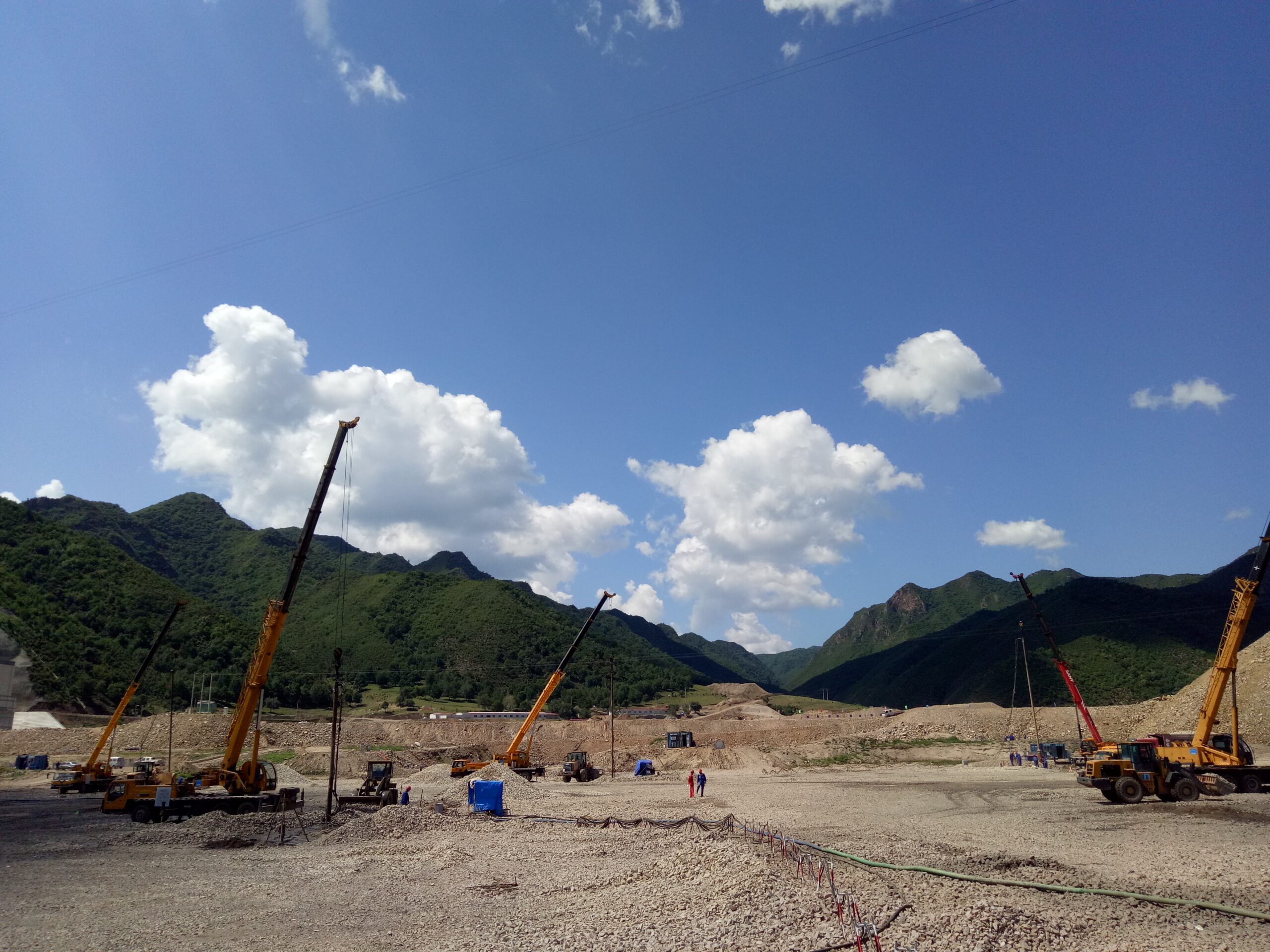
Located in Fengning Manchu Autonomous County, Hebei Province, China, the Hebei Fengning Pumped Storage Power Station is a flagship national energy infrastructure project with a planned capacity of 3,600 MW. Designated as a key Type-I civil project, it serves vital functions for the Beijing-Tianjin-Tangshan power grid—including peak shaving, valley filling, frequency regulation, phase adjustment, and emergency power backup.
A critical water-retaining component of this facility is the sediment retention dam for the lower reservoir. Designed as a composite geomembrane core rockfill dam, it features a maximum height of 23.5 meters and a crest length of 548 meters. The structural integrity of the dam relied heavily on the foundation’s load-bearing capability and seismic stability. However, initial geotechnical site investigations revealed deep, high-compressibility soft riverbed overburden with a natural bearing capacity of only 80 kPa, far short of the project’s design safety requirement of ≥250 kPa.
Geological Conditions & Complex Hazards
The site presented a formidable set of engineering challenges requiring robust foundation remediation:
Inhomogeneous Soft Surface Stratum: The upper riverbed layer was composed of a 4-to-11-meter-thick layer of highly heterogeneous silty soil (silty clay and fine sand mix). Natural soil density varied wildly between 1.56 and 1.97 g/cm³, with a plasticity index ranging from 9.2 to 33.2, indicating severe local variability and poor natural structural support.
Dense Underlying Bedrock & Gravel: Beneath the soft silt lay a 21-to-24-meter-thick, highly dense sand-gravel-cobble stratum above fine-grained granite bedrock. Stone columns needed to fully penetrate the soft silt layer and key deep into this dense gravel formation.
High Seismic Acceleration & Liquefaction Hazards: The project area sits in a high seismic risk zone, with a basic peak ground acceleration of 0.45g (10% exceedance probability in 50 years, basic intensity VI degree). Under earthquake conditions, saturated silty/sandy layers faced severe liquefaction risk, which threatened catastrophic post-earthquake settlement or dam failure.
Engineering Solution & Technical Parameters
To meet stringent stability and seismic standards cost-effectively, engineers selected the Vibro Replacement Stone Column (Vibroflotation) Method. By displacing soft silt with dense, compacted crushed stone columns in a matrix pattern, the system creates a high-performance composite foundation with rapid drainage channels that dissipate excess pore water pressure during seismic events.
Column Diameter: 1.2 meters
Grid Pattern & Spacing: Triangular (quincunx) arrangement at 1.5-meter center-to-center spacing, yielding a exceptionally high area replacement ratio of 50%.
Column Length: 10 to 13 meters (designed to fully pass through the silty soil layer and embed at least 1.0 meter into the underlying sand-gravel-cobble stratum).
Treatment Scope: 60,000 square meters of dam foundation area; total volume exceeding 30,000 columns and 360,000 linear meters of stone columns.
Backfill Material: Hard, durable graded crushed stone aggregate (20–120 mm grain size) sourced directly from the project site quarry.
Equipment Performance & Field Execution
Executing a 360,000-meter stone column workload through abrasive, heterogeneous soils into dense gravel layers requires heavy-duty equipment capable of sustained vibration force and high operational reliability.
Core Equipment Fleet
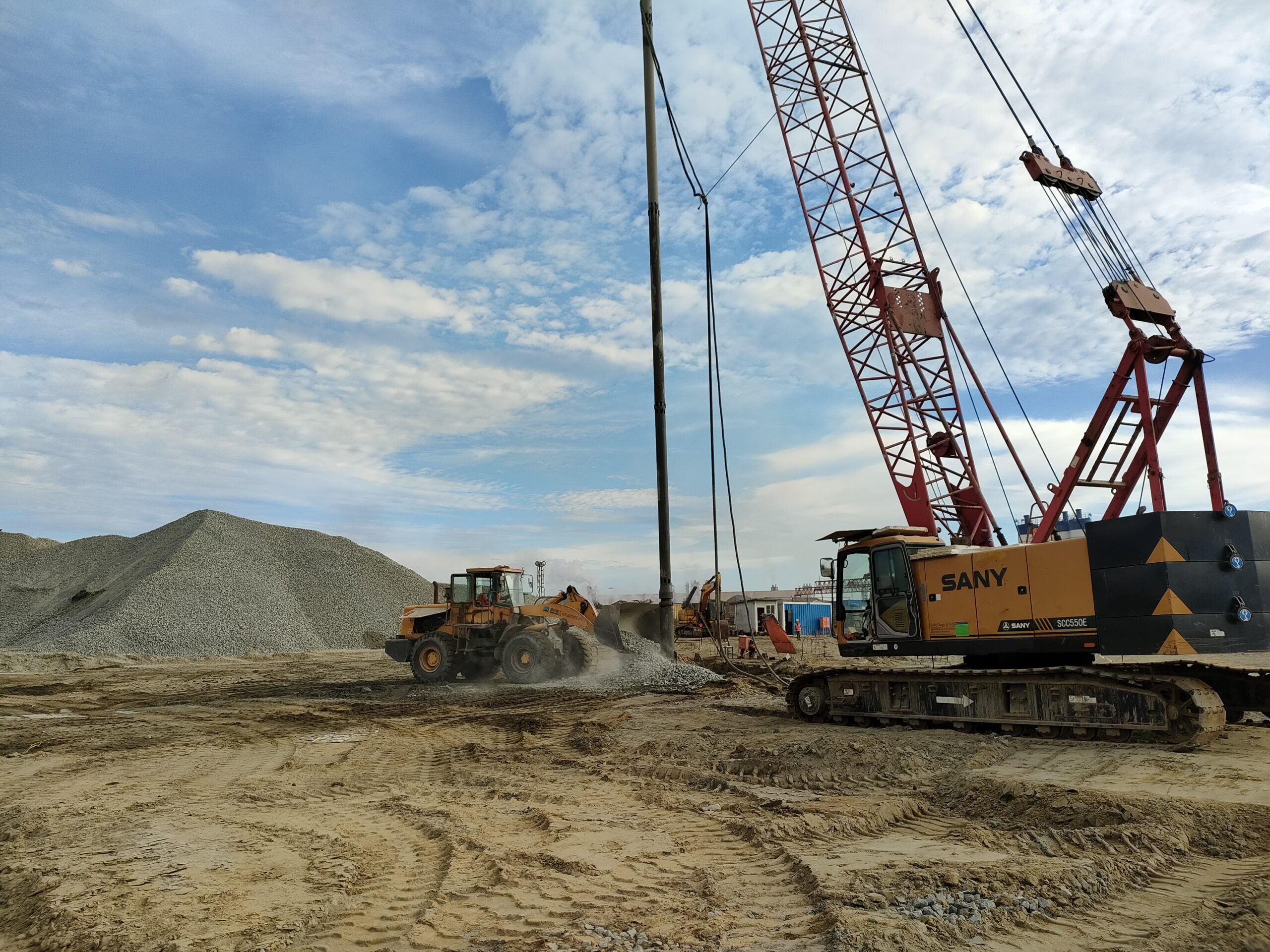
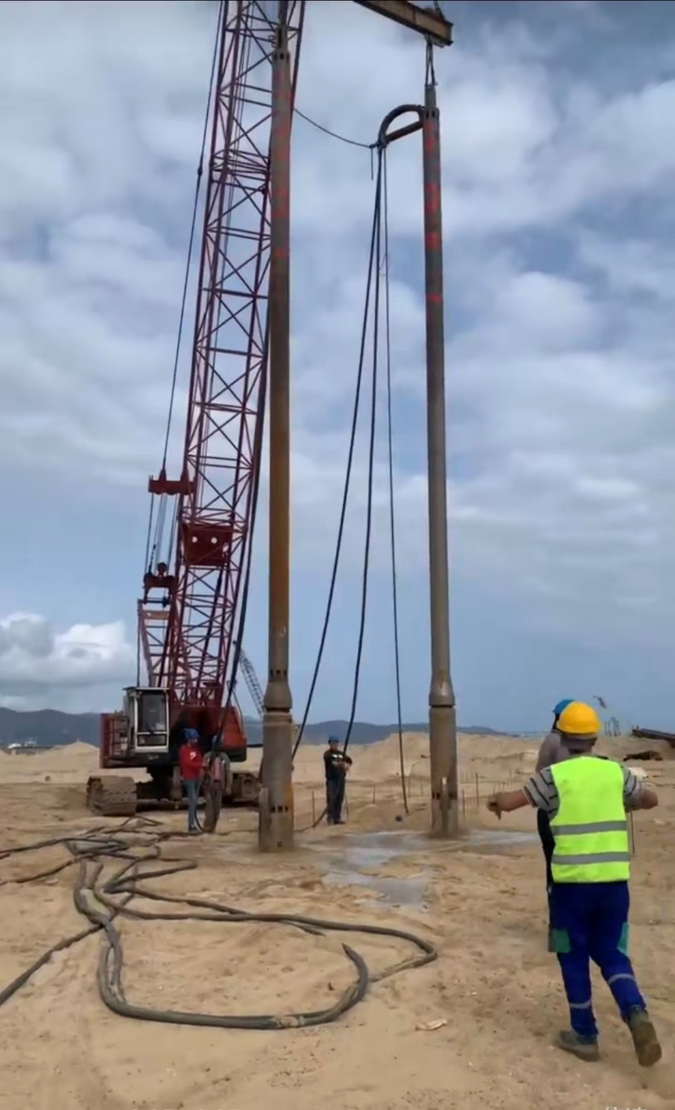
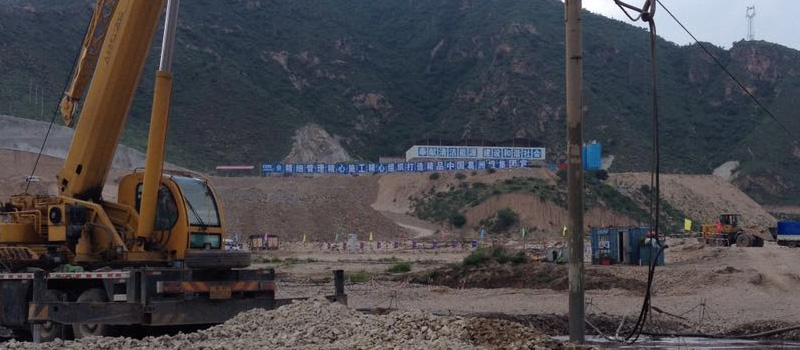
The construction was anchored by multiple BVEM BJVE-75 heavy-duty electric vibroflots, supported by 16–25 ton truck crane rigs for vertical suspension and 1.5–3.0 m³ wheel loaders for continuous aggregate feeding.
Rigorous Process Parameter Control
Jetting Water Pressure (Hole Formation): Maintained at 0.4–0.6 MPa to ensure rapid penetration through sticky silt layers down to the target socketing depth.
Compaction Water Pressure: Adjusted to 0.3–0.5 MPa during stone backfilling to compact stone lifts without flushing away structural fines.
Densification Current Threshold: Fixed at 90 Amperes. Motor current was monitored in real-time; the vibroflot remained at each compaction segment until the motor current stabilized at 90A, confirming optimal stone packing.
Lift Step & Retention Time: Compaction segment length was kept at 30–50 cm, with a vibro-retention dwell time of 10–12 seconds per segment.
Science-Backed Calibration (Test Pile Program)
Before full-scale production, a rigorous field trial program featuring 45 trial columns was conducted. Continuous monitoring of penetration rates, jetting pressure, motor amperage, and stone consumption established exact field baseline parameters, ensuring uncompromised execution across all 30,000+ production columns.
Quality Assurance & Testing Outcomes
Independent geotechnical verification post-construction confirmed outstanding ground improvement performance:
357% Bearing Capacity Increase: Single-column composite foundation static load testing demonstrated an average characteristic bearing capacity value of 366 kPa. This far exceeded both the pre-treatment baseline (80 kPa) and the structural requirement (≥250 kPa).
Complete Liquefaction Risk Elimination: Post-construction Standard Penetration Tests (SPT) on inter-column soil showed that blow counts in the surrounding silty sand increased substantially to medium-dense and dense states, completely eliminating seismic liquefaction potential under 0.45g ground acceleration.
Uncompromising Column Integrity: Heavy Dynamic Penetration (N63.5) testing confirmed dense, continuous stone compaction throughout the entire column shaft, with uniform keying into the bottom gravel stratum.
Value Delivered & Key Takeaways for Equipment Buyers
Equipment Durability under Heavy Duty Cycles: Deep penetration through dense sand, silt, and cobble layers demands vibroflots engineered with high mechanical torque, advanced motor waterproofing/sealing, and efficient heat dissipation. The BJVE vibroflot demonstrated zero mechanical downtime throughout 360,000 meters of drilling.
Superior Cost Efficiency: Compared to deep bored piling or massive excavation/replacement, the Vibro Replacement Stone Column method reduced overall foundation construction time by 30% and cut direct foundation engineering costs by approximately 40%.
Turnkey Technical & Equipment Partnership: Beyond equipment supply, BVEM leverages over 50 years of field construction heritage under POWER CHINA. Equipment clients receive full lifecycle engineering support—from parameter optimization and test pile trials to on-site operator training and QC verification.