Foundation bearing capacity tells you how much load the ground can safely support. When you plan a construction project, understanding soil conditions is essential. Soil strength, density, moisture content, and groundwater levels all affect how well the ground can support a structure. If the ground is not strong enough, the foundation may experience excessive settlement or even fail. This guide covers the main factors, different soil types, testing methods, and ways to improve soil strength.
What Is Foundation Bearing Capacity?
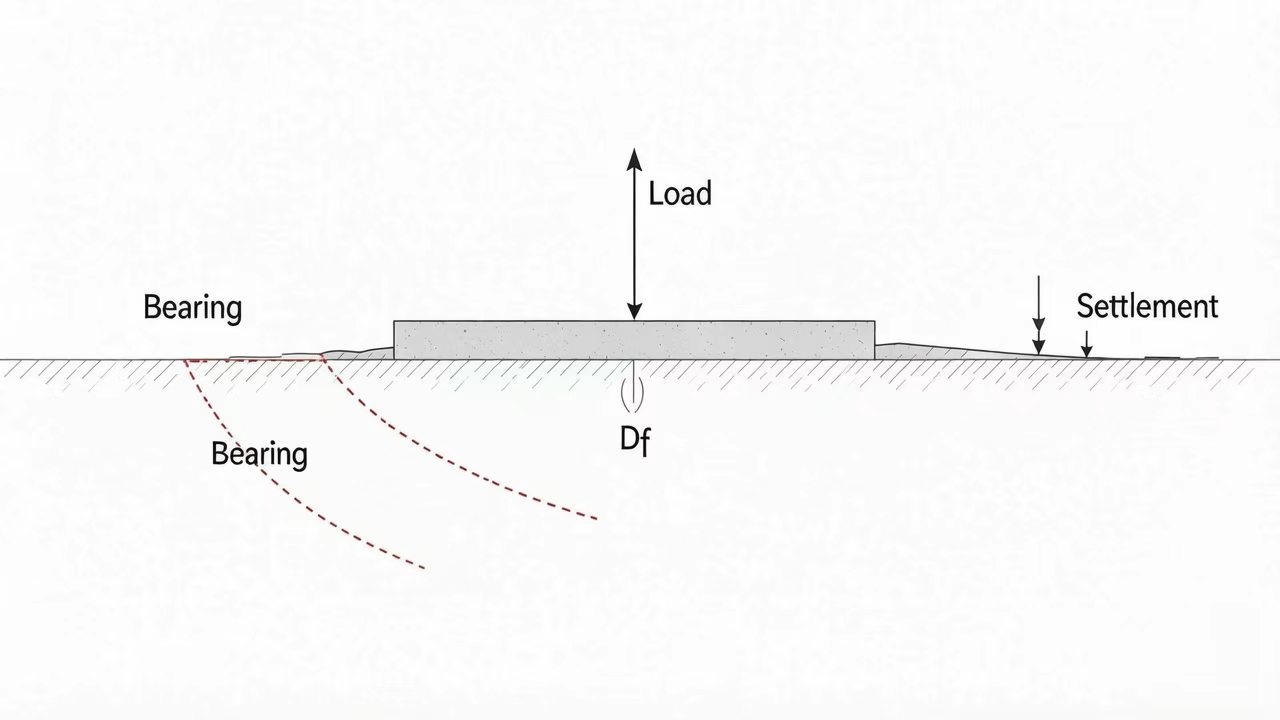
Foundation bearing capacity refers to how much load the soil can safely support through a building’s foundation. It means the soil must be able to support the pressure without shear failure. This depends on factors such as soil strength, foundation size, embedment depth, and groundwater conditions.
In foundation design, two terms are commonly used:
Ultimate Bearing Capacity: The maximum pressure the soil can support before shear failure occurs.
Allowable Bearing Capacity: The pressure permitted for foundation design after considering a suitable safety factor and other design requirements.
However, bearing capacity is not the only thing you need to consider. Even if the soil can support the applied load without shear failure, the foundation may still experience excessive settlement. Total settlement and differential settlement must also be checked to make sure the building remains stable and performs as expected.
What Factors Affect Foundation Bearing Capacity?
Several factors can affect how much load a foundation can safely support. Soil properties, foundation design, and ground conditions all play a role. When you evaluate a construction site, you need to consider all these factors rather than look at soil type alone.
Bearing Characteristics of Different Soil Types
Different soil types have different bearing characteristics. The table below shows the general bearing characteristics of common soils under foundation loads.
| Soil Type | General Bearing Characteristics |
| Rock | Generally provides high bearing resistance, depending on rock quality and weathering. |
| Dense Gravel | Usually provides good support and drainage. |
| Dense Sand | Usually provides good support when properly compacted. |
| Loose Sand | Has lower stiffness and may be more prone to settlement. |
| Stiff Clay | Usually provides better support than soft clay. |
| Soft Clay | Often has low shear strength and high compressibility. |
| Silt | Its performance varies with moisture content and density. |
| Organic Soil | Usually provides poor support and has high compressibility. |
These descriptions are general and should not be used as fixed design values. You cannot determine bearing capacity from the soil name alone. For example, dense sand and loose sand can behave differently under the same foundation load. A site investigation is needed to identify the actual soil conditions.
Soil Density and Compaction
The arrangement of soil particles affects how they transfer loads. Loose granular soils have more open spaces between particles, while dense soils have fewer voids and usually provide better support. Compaction can improve the engineering properties of suitable granular soils.
Moisture Content and Groundwater Level
Water conditions can change how soil behaves. In some soils, higher moisture content reduces strength. A rising groundwater level can also reduce effective stress in saturated granular soils, which may affect foundation design.
Foundation Size and Depth
The width, shape, and embedment depth of a foundation influence how loads spread through the ground. These dimensions must be considered together with the soil profile and structural loads.
Soil Layering
Soil conditions can change with depth. A dense surface layer does not always mean that the ground below is suitable for a foundation. If a weak layer lies beneath it, the foundation may still experience excessive settlement or bearing failure under load.
How Is Foundation Bearing Capacity Determined?
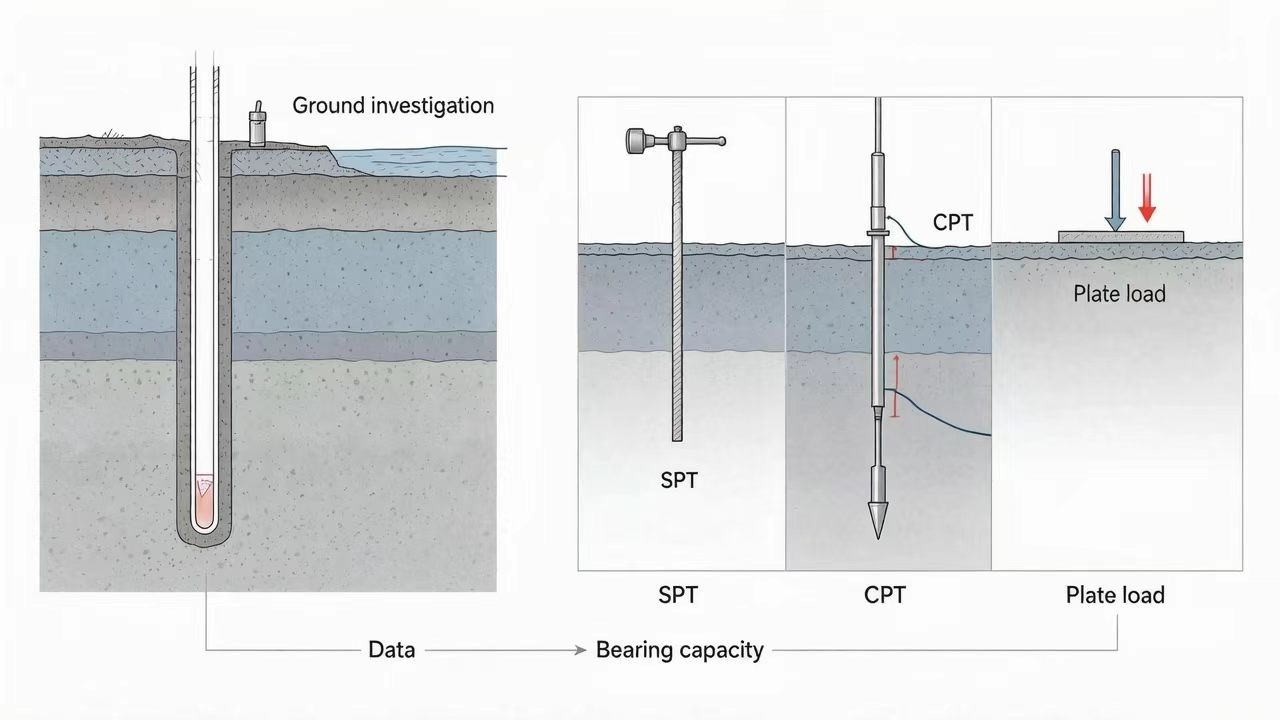
Before you design a foundation, you must first understand the soil conditions at the construction site. Engineers rely on geotechnical investigations and field tests to gather the data needed to evaluate soil bearing capacity.
Geotechnical Investigation
A geotechnical investigation looks at soil layers, groundwater levels, soil properties, and any weak layers below the ground. This information gives engineers a picture of what lies beneath the surface before foundation design begins.
Standard Penetration Test (SPT)
The Standard Penetration Test measures soil resistance during drilling. The result, called the SPT N-value, helps engineers estimate the relative density of granular soils and the consistency of cohesive soils.
Cone Penetration Test (CPT)
The Cone Penetration Test pushes a cone into the ground and records the resistance at the tip and the friction along the sleeve. These readings help engineers identify soil layer boundaries and understand the engineering behavior of the soil.
Plate Load Test
In a plate load test, a steel plate is placed on the ground and pressure is applied to it. The test records how much the ground settles under load. This helps engineers evaluate the load-settlement response of the soil at the test location.
The actual allowable bearing capacity must be determined through geotechnical investigation, engineering analysis, and appropriate field tests. SPT and CPT results are useful for estimating soil properties, but they do not directly provide the allowable bearing capacity. This value must be determined using the collected data and engineering judgment.
How to Calculate Foundation Bearing Capacity?
After you have gathered the necessary soil data, you can estimate foundation bearing capacity using soil properties and foundation dimensions. The Terzaghi bearing capacity equation is a commonly used method for shallow strip foundations.
The general formula for the bearing capacity of soil is:
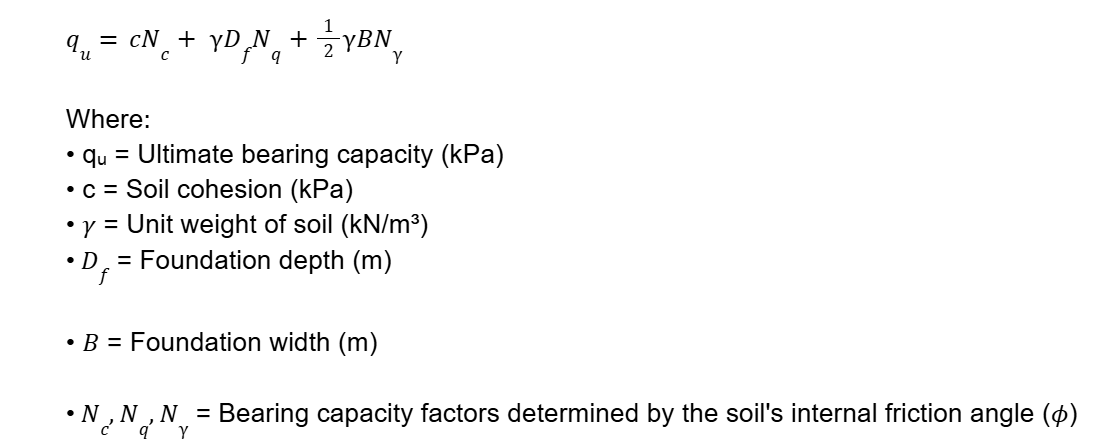
The equation takes into account soil cohesion, foundation depth, soil unit weight, and foundation width. These factors help you estimate the pressure the soil can support before shear failure occurs.
Once you have calculated the ultimate bearing capacity, you need to apply a factor of safety (FS) to estimate the safe bearing pressure. A factor of safety of around 3 is commonly used in preliminary calculations, but the appropriate value depends on the design requirements.
You also need to consider the soil type when evaluating bearing capacity. For clay, engineers typically use undrained shear strength for short-term estimates. For sand and gravel, soil density and effective friction angle are important. Groundwater conditions can also affect the calculation.
The formula is based on simplified ground and loading conditions. If you have different soil layers, uneven ground, or complex foundation loads, further analysis is needed. You should also check how much the ground may settle because the allowable bearing pressure must satisfy both shear failure and settlement requirements.
How to Improve Foundation Bearing Capacity?
When the existing ground cannot meet project requirements, you may need to improve its engineering properties before foundation construction. The right method depends on ground conditions, treatment depth, site access, and project requirements. Common options include soil replacement, ground compaction, stone columns, and other ground improvement techniques.
Soil Replacement
Soil replacement means removing weak surface soil and filling the area with suitable sand, gravel, or other engineered materials. It is often used for shallow weak layers where excavation is practical. For deeper soft soil, other improvement methods may be more suitable.
Vibro Compaction
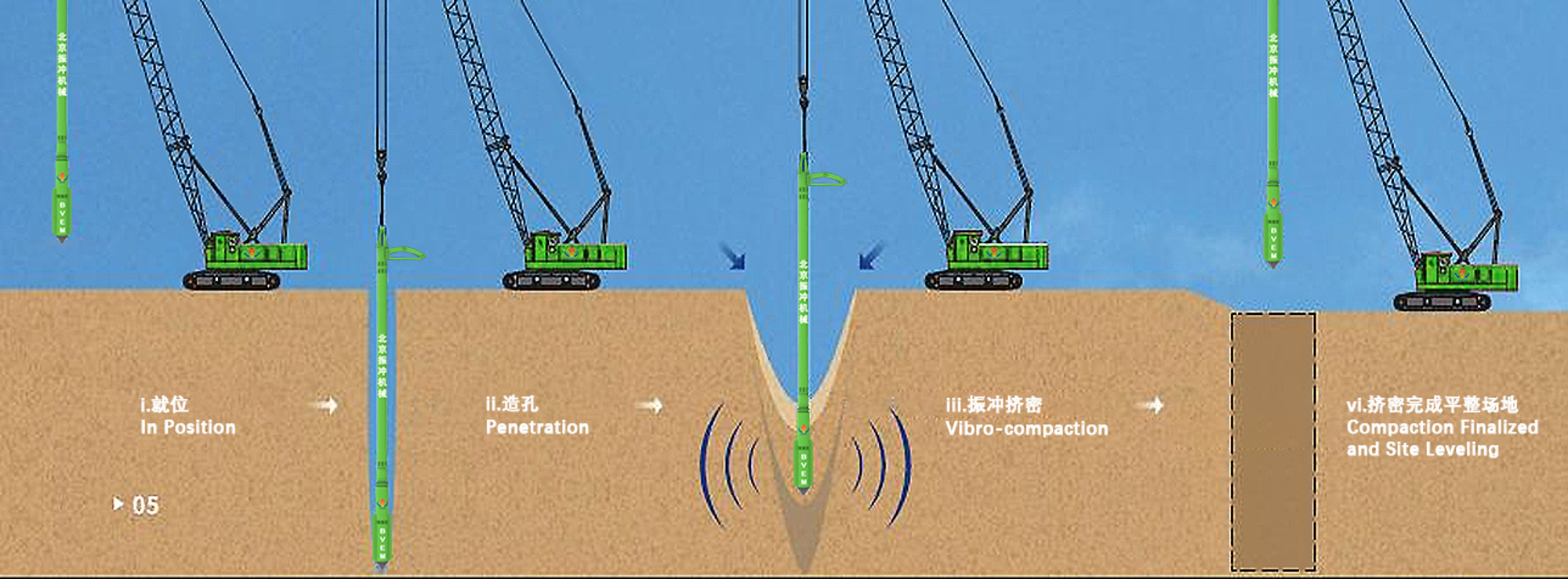
Vibro compaction uses a vibrating probe called a vibroflot to densify suitable granular soils. As the probe enters the ground, horizontal vibrations help loose soil particles rearrange into a denser structure.
This method is generally most effective in loose sand and gravel with a low fines content, typically around 10% or less. By increasing soil density, vibro compaction improves ground strength and stiffness, helping the treated soil support foundation loads more effectively.
Depending on the project, you can use an electric vibroflot or a hydraulic vibroflot. The setup may also include a crane, power supply, electrical control cabinet, and water supply system.
Unlike stone columns, vibro compaction improves the existing soil without forming separate aggregate columns.
Vibro Replacement (Stone Columns)
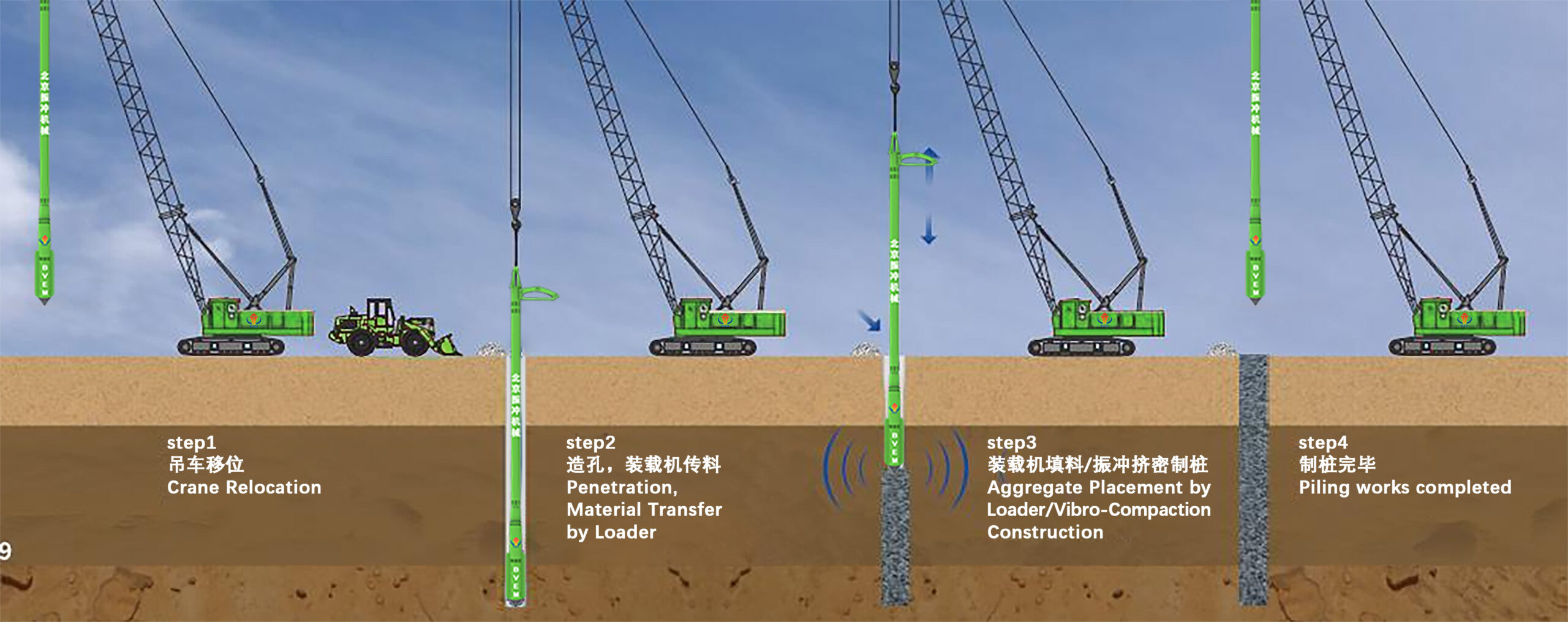
Vibro replacement uses a vibroflot to create holes that are filled with gravel or crushed stone. The material is compacted in stages to form stone columns. These columns work with the surrounding soil to create a composite ground system. They can also provide drainage paths and help control settlement.
This method may be suitable for some soft clay, silt, and other weak soils, provided the ground has enough lateral support. You can choose between top-feed and bottom-feed vibroflots according to the feeding method, soil conditions, and construction requirements.
Deep Soil Mixing
Deep soil mixing blends cement or other binding materials with the soil in place. The treated soil forms soil-cement columns or panels, which can improve ground strength and reduce deformation. This method is commonly considered for some soft clay deposits.
Preloading and Vertical Drains
Preloading applies temporary loads to soft ground before construction. Vertical drains, such as prefabricated vertical drains, help water escape from the soil and speed up consolidation, reducing future settlement.
Dynamic Compaction
Dynamic compaction uses a heavy weight dropped repeatedly from a certain height to densify loose fill and suitable granular soils. It can treat large areas, but construction vibration should be considered when nearby buildings or facilities are present.
How to Choose the Right Ground Improvement Method and Equipment?
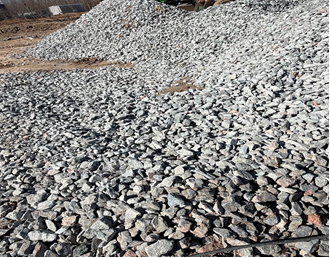
Choosing a ground improvement method is not just about soil type. You also need to consider other project conditions before making a decision.
- Soil Conditions: Look at the soil type, particle size, fines content, and soil strength.
- Required Treatment Depth: Find out how deep the weak soil extends and how deep the improvement needs to reach.
- Bearing Capacity and Settlement Requirements: Understand how much load the ground needs to support and how much settlement is acceptable.
- Groundwater and Site Conditions: Check the groundwater level, available working space, and how easy it is to bring equipment and workers to the site.
- Available Equipment and Power Supply: Consider what machines are available on site, such as cranes and excavators, and whether there is enough power and water for the work.
After reviewing these factors, you can compare different ground improvement methods and choose the one that best fits the site conditions and construction requirements.
FAQs About Foundation Bearing Capacity
What Is the Difference Between Soil Bearing Capacity and Foundation Bearing Capacity?
Soil bearing capacity refers to the ability of the soil to support loads without failure or excessive settlement. Foundation bearing capacity refers to the pressure that a specific foundation can safely transfer to the supporting ground. When you evaluate a foundation, you need to consider both the soil properties and the foundation’s size, shape, and depth. These factors work together to determine how much load the ground can safely support.
What Should You Do If Actual Soil Conditions Differ from the Geotechnical Report?
If the soil conditions found during construction differ from the geotechnical report, you should not proceed with the original design without further evaluation. You need to inform the geotechnical engineer and review the actual ground conditions. Additional soil investigation or testing may be required. Based on the findings, the foundation design or ground improvement plan may need to be adjusted to meet the project requirements.
Can Bottom-Feed Vibroflotation Be Used Without Water?
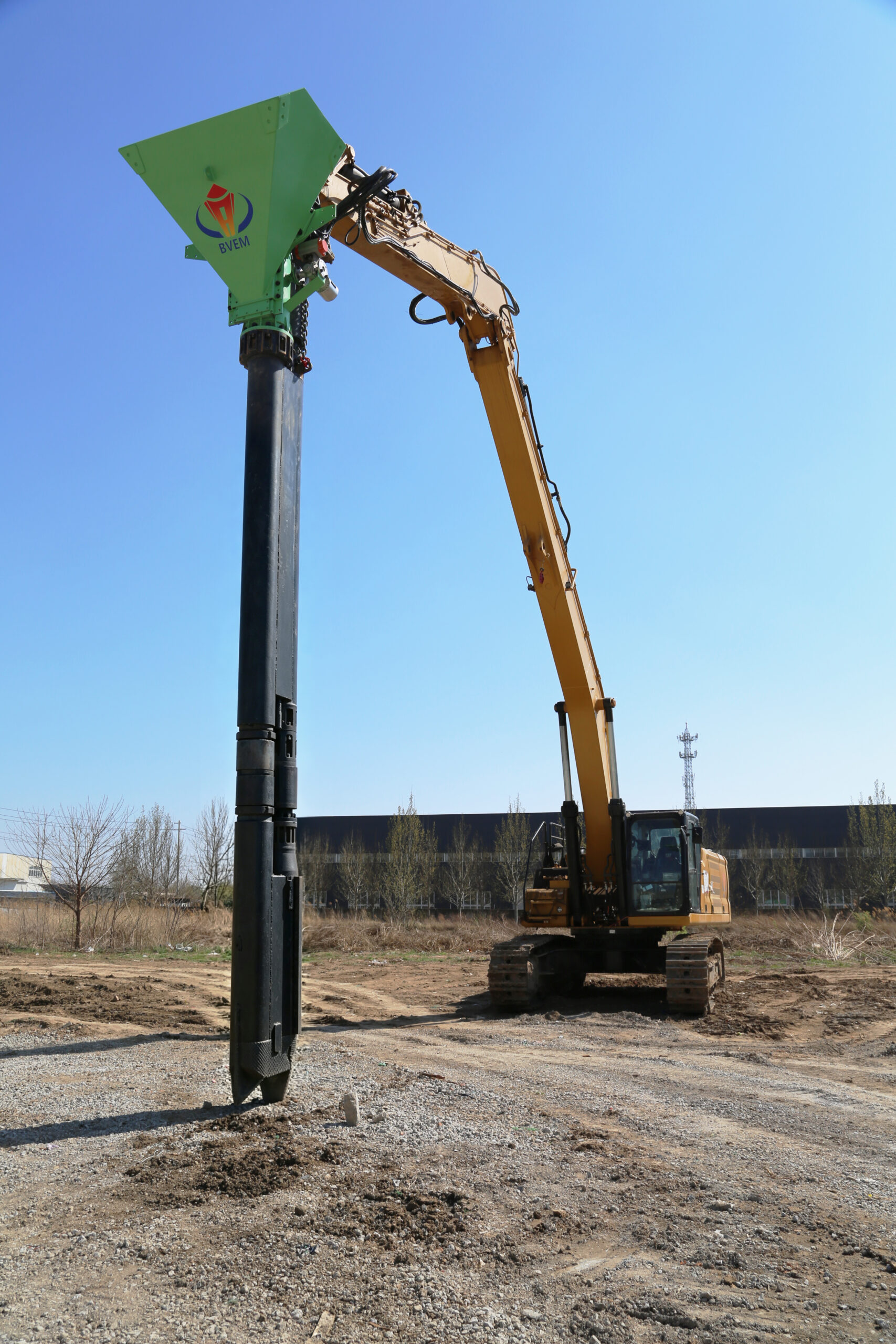
Bottom-feed vibroflotation supports different construction methods, including dry, wet, and combined dry-and-wet methods. Dry construction is useful when you work in areas where water resources are limited or wastewater discharge is restricted. It can also help avoid disturbing the natural particle-size distribution of the surrounding soil when dry construction is required. Depending on soil hardness and hole formation efficiency, you can also choose wet or combined dry-and-wet construction. This gives you more flexibility to adapt the method to different site conditions.
What Are the Advantages of Bottom-Feed Vibroflotation for Offshore Construction?
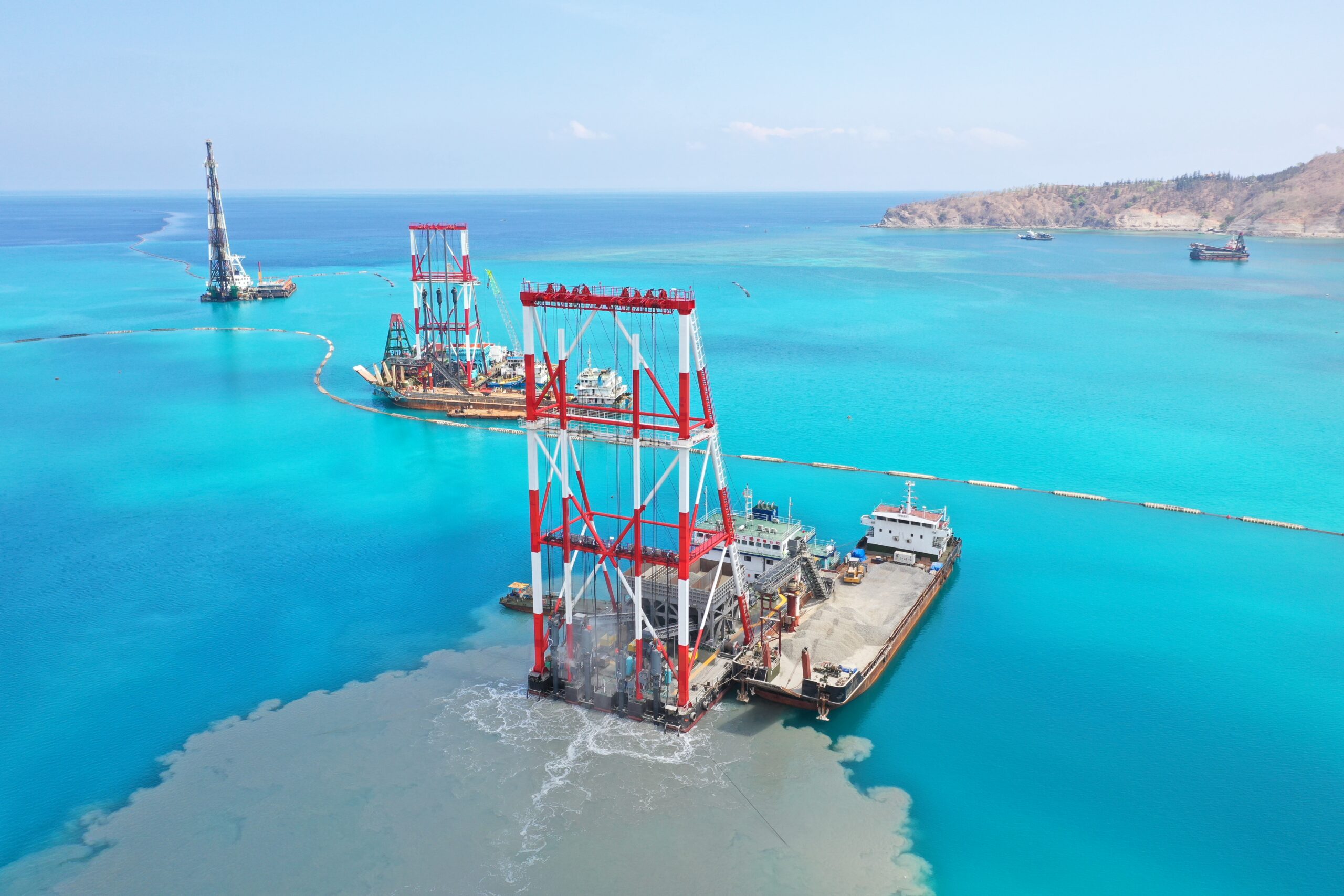
Bottom-feed vibroflotation offers several advantages for offshore construction. You can use bottom-feed vibroflotation systems on construction barges equipped with automated aggregate feeding systems. On suitable construction barges, GPS positioning, video monitoring, and intelligent construction management systems can help operators monitor and control the stone column installation process from a central control room. These systems help improve construction efficiency, aggregate feeding accuracy, and quality control during underwater stone column construction.
How Do You Verify Foundation Bearing Capacity After Ground Improvement?
After ground improvement, you should carry out field tests to check whether the treated ground meets the design requirements. Common methods include the Cone Penetration Test (CPT), the Standard Penetration Test (SPT), and the plate load test. You can compare the post-treatment test results with the original soil data and design requirements to evaluate how effective the improvement has been. In some projects, you may also need to monitor settlement and pore water pressure. The testing plan should be based on the ground improvement method and project specifications.
Need Reliable Equipment for Your Ground Improvement Project?
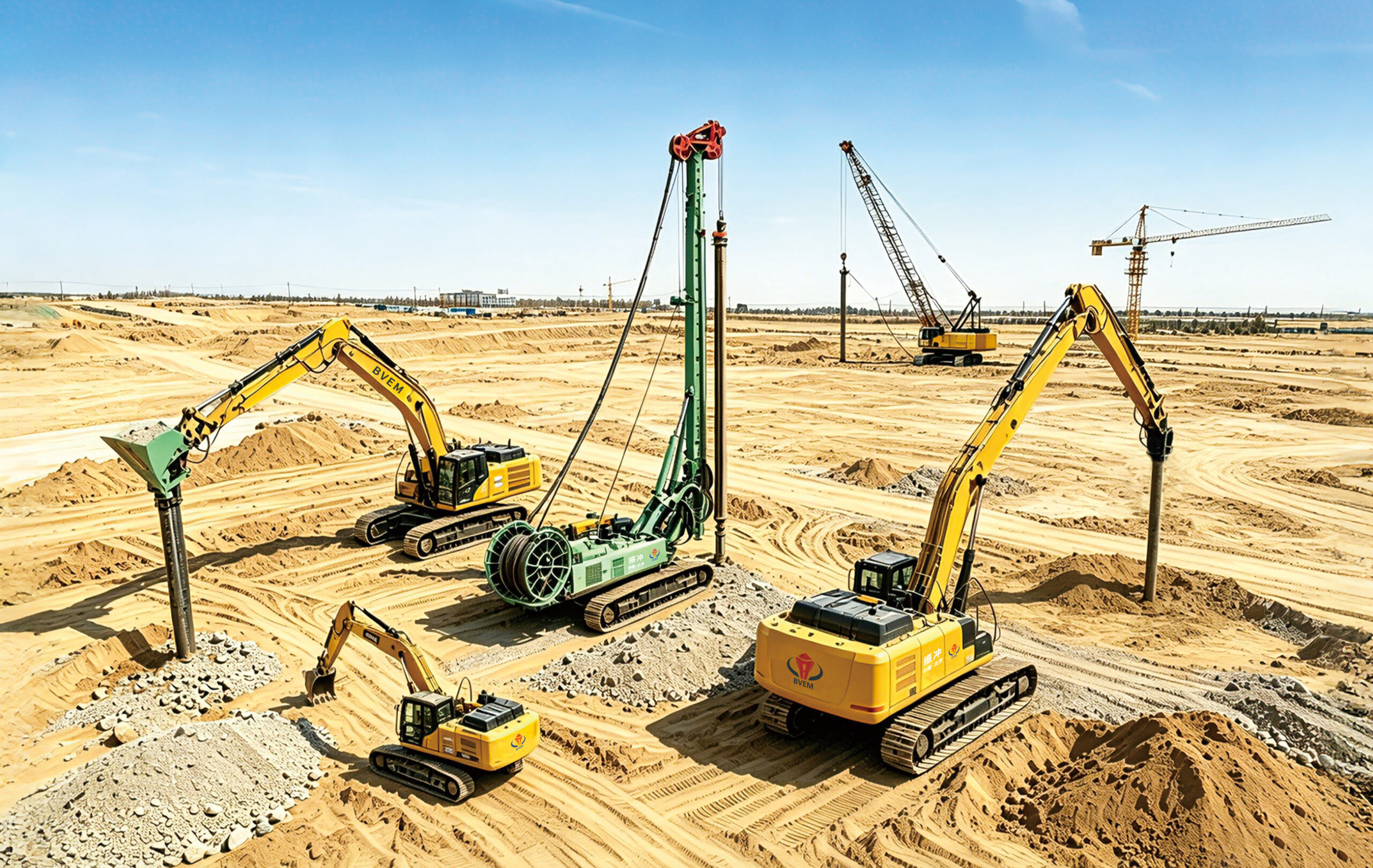
BVEM has over 50 years of experience in vibroflot research, development, and manufacturing, with more than 1,500 projects completed in over 60 countries. We supply electric and hydraulic vibroflots, including top-feed and bottom-feed systems. We also provide excavators, piling rigs, generators, and other construction equipment, offering one-stop machinery solutions for your projects.
Contact us to find the right equipment for your project.