Executive Summary
Project Name: Skikda Oil & Gas Port Expansion & Modernization Project
Project Location: Skikda, Eastern Algeria
Facility Type: Major Liquefied Natural Gas (LNG) Loading & Export Terminal
Core Technology: Deep Vibro-compaction (Vibroflotation Method)
Key Equipment: BVEM BJVE -130 kW Electric Vibroflots
Treatment Scope: 145,000 square meters; treatment depth up to 11.5 meters
Primary Outcomes: Achieved Dr ≥60% relative density; bearing capacity exceeding 200 kPa; post-construction dynamic settlement strictly controlled under 100 mm over 50 years.
Project Background & Strategic Significance
The Skikda Oil and Gas Port, strategically situated on the Mediterranean coast of eastern Algeria, serves as a core conduit for North Africa’s energy exports to European and global markets. To accommodate next-generation LNG carriers and heavy industrial equipment, the Algerian port authority initiated a major expansion and modernization scheme. Once fully operational, this flagship infrastructure project will transform Skikda into the country’s largest LNG loading hub, driving local logistics, equipment servicing, and regional energy supply chains.
The expansion scope required reclaiming extensive land from the sea to house heavy-duty container yards, bulk sulfur storage facilities, and critical port operation zones. Because LNG infrastructure is exceptionally sensitive to differential settlement, the structural integrity of the reclaimed platform was paramount. Project engineers were tasked with converting loosely dumped hydraulic sand fill into a ultra-stable, heavy-load composite platform capable of supporting intense dynamic traffic and long-term static storage.
Geological Conditions & Geotechnical Challenges
The project platform was created entirely through hydraulic reclamation. Site characterization and geotechnical boreholes revealed severe structural vulnerabilities within the untreated foundation soil:
Hydraulic Sand Fill Stratum: The upper formation consisted of hydraulically placed medium-coarse sand with a loose-to-very-loose state. The fill thickness varied across the site from 1.5 to 9.0 meters.
High Liquefaction Risk & Loose Packing: The natural soil matrix exhibited low relative density Dr ≤40% with high void ratios, making it highly susceptible to static settlement under heavy port loads and dynamic liquefaction under seismic or wave-induced excitation.
Gradation Profile: The backfill material contained particles up to 100 mm. However, the fines content (particles < 0.063 mm) was consistently controlled under 10%—an ideal candidate profile for deep vibro compaction, provided sufficient energy input could be delivered into the soil matrix.
Rigorous Performance Mandates
The port design authorities imposed non-negotiable structural criteria for the foundation:
Long-Term Settlement Control: For container and heavy storage yards, total post-construction settlement over a 50-year service life had to remain below 100 mm below the design invert.
Deep Densification Threshold: Relative density of both the hydraulic fill and underlying native sand layers within 15 meters below design elevation had to achieve ≥60% uniformly.
Pavement Layer Compaction: Top structural layers required a compaction degree of at least 95% of maximum dry density.
Target Bearing Capacity: The final composite platform needed to deliver a characteristic bearing capacity of no less than 200 kPa.
Engineering Solution: Vibro compaction Method
To achieve uniform deep compaction across 145,000 square meters without the high capital cost of imported stone backfill or deep concrete piling, engineers selected the Vibro compaction Method (Vibroflotation without aggregate addition).
By inserting a high-frequency horizontal vibrator into the saturated sand layer, powerful centrifugal forces temporarily fluidize the surrounding sand particles. Soil cohesion drops to zero, allowing gravity and horizontal vibrations to rearrange sand grains into a dense, interlocking triangular packing structure.
Detailed Treatment Parameters
Treatment Scope: 145,000 m² total ground area
Treatment Depth: 1.5 to 11.5 meters
Grid Pattern & Spacing: Triangular layout at 3.5-meter center-to-center grid spacing
Equipment Selection: BVEM 130 kW High-Efficiency Heavy-Duty Electric Vibroflot System
Surface Secondary Compaction: “Vibro compaction + 15-ton heavy roller compaction” dual-stage finish
Equipment Performance & Execution Methodology
Heavy-Duty Equipment Rigging
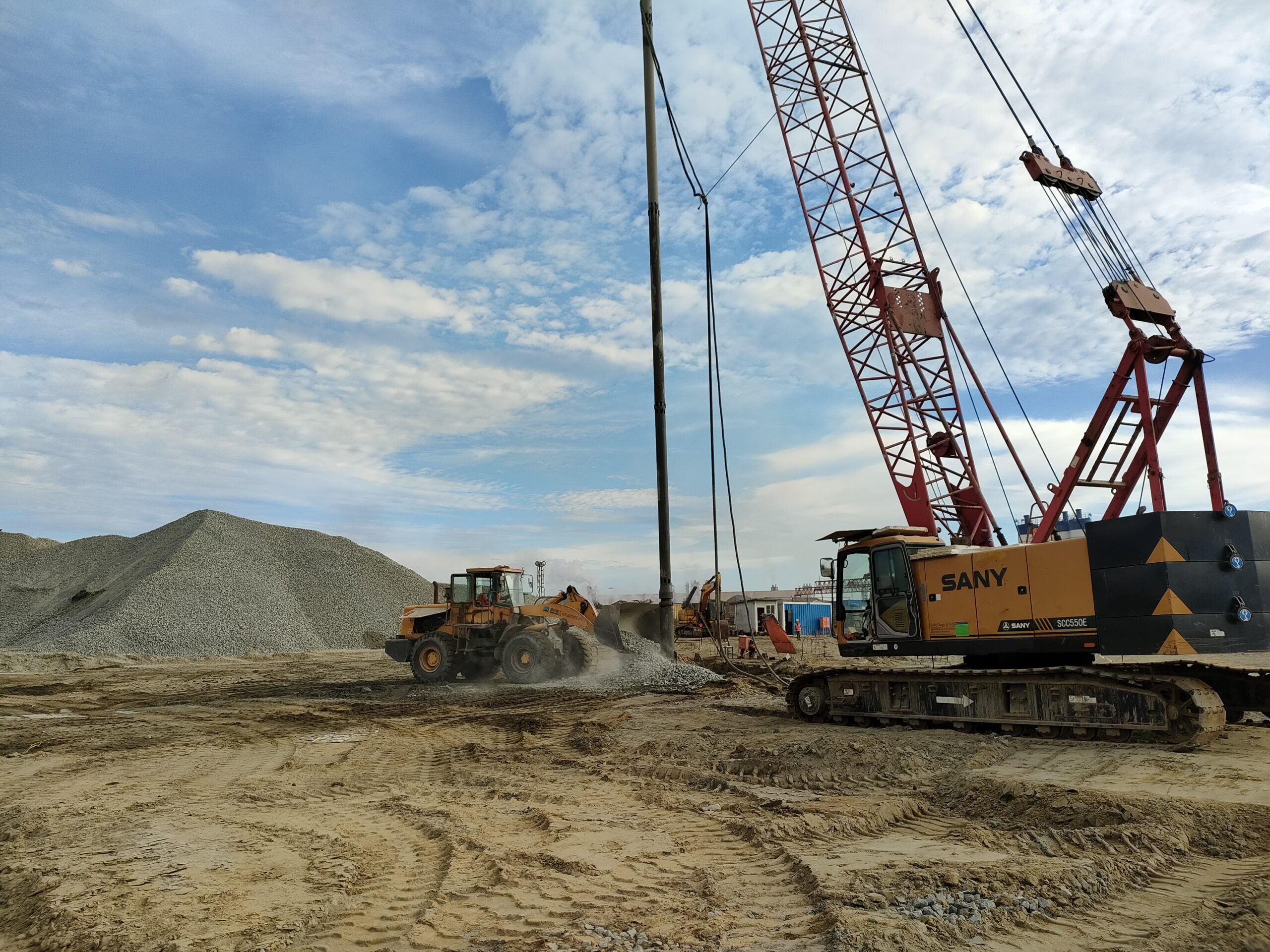
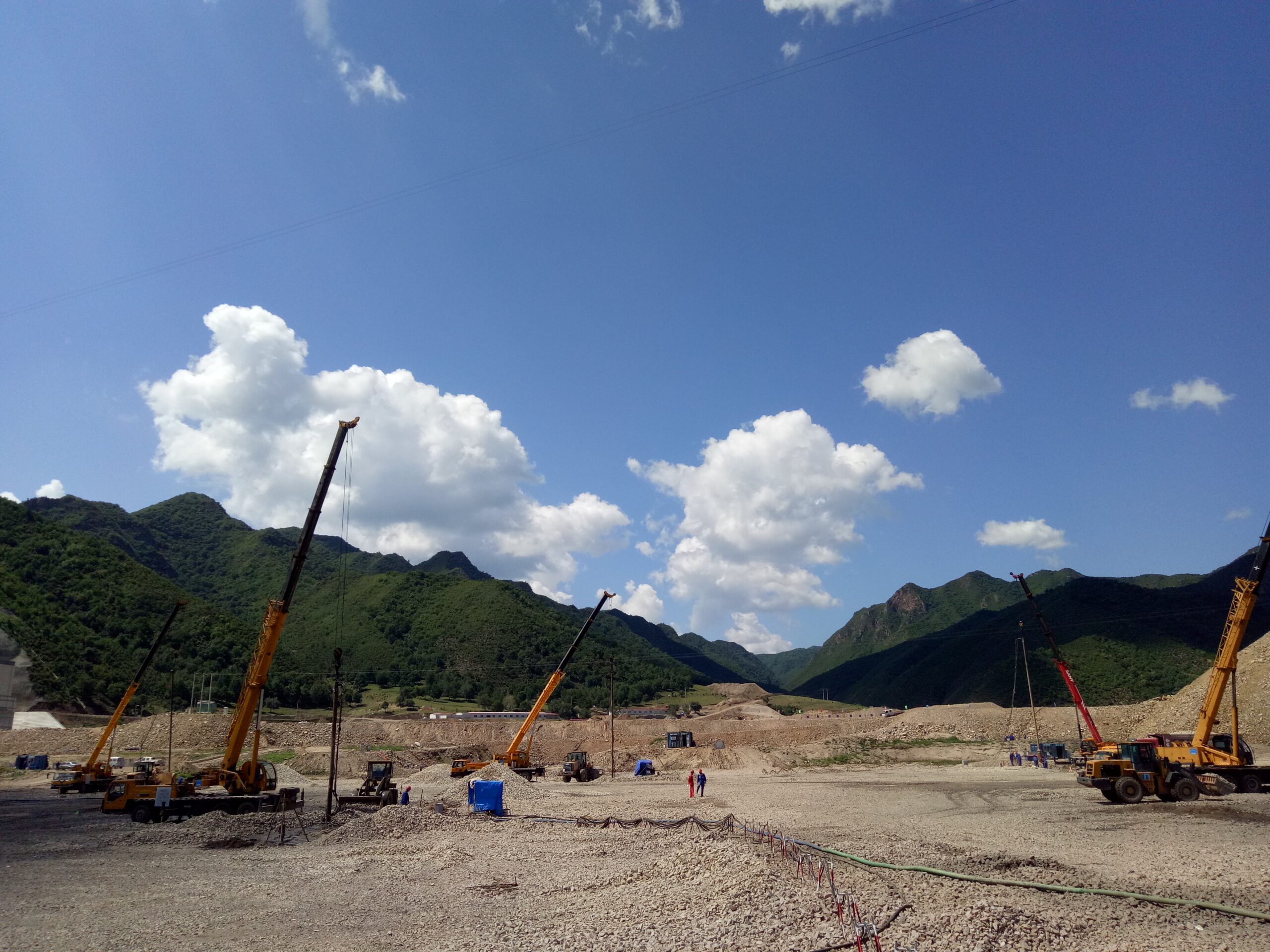
Deep compaction in medium-coarse sand up to 11.5 meters deep demands equipment with massive motor torque, extreme penetration power, and rapid cycle times. The project deployed high-powered BVEM BJVE 130 kW electric vibroflot units mounted on heavy crawler cranes.
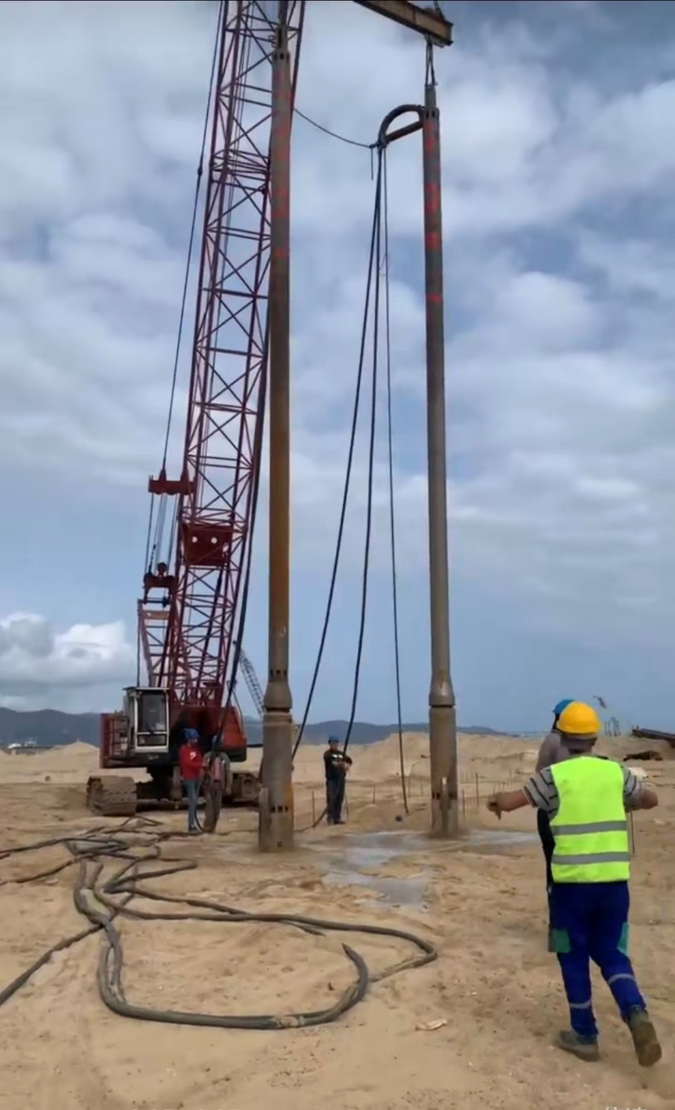
To double operational output across the massive 145,000 m² footprint, contractors utilized custom multi-vibroflot tandem suspension systems. As captured in field operations, twin 130 kW vibroflots suspended from a heavy lattice-boom crawler crane performed simultaneous penetration and compaction cycles, cutting overall jobsite execution time in half while maintaining pinpoint grid precision.
Strict Process Parameter Control
Penetration & Water Flushing: The 130 kW vibroflot utilized high-pressure water jetting at 0.5–0.8 MPa to penetrate rapidly through thick hydraulic sand down to the maximum design depth of 11.5 meters.
Compaction Steps & Amperage Control: The vibroflot was lifted in step increments of 30–50 cm. At each compaction step, the unit was held in place until the motor operating current reached the predefined densification threshold (indicating high resistance from densely packed sand grains).
Crater Backfilling: As sand densified downward and laterally, a conical depression formed at the surface. Top sand was continuously pushed into the crater to maintain surface grade before final heavy rolling.
Quality Assurance & Post-Treatment Verification
Comprehensive post-construction testing was performed across the entire 145,000 m² site to verify ground compliance against all contract specifications:
Target Relative Density Achieved (Dr ≥60%): Post-treatment Cone Penetration Testing (CPT) and Standard Penetration Testing (SPT) confirmed that sand relative density across the entire 1.5–11.5 m depth profile comfortably exceeded the 60% requirement, shifting the sand state from loose to dense.
350–400 mm Immediate Ground Settlement: The vibro compaction process induced an immediate surface collapse/settlement of approximately 40 cm during construction. This massive pre-construction volume reduction successfully eliminated future long-term settlement, ensuring the 50-year <100 mm requirement was effortlessly met.
Superior Bearing Capacity (≥200kPa): Large-scale plate load tests confirmed that the allowable bearing capacity reached and exceeded 200 kPa, establishing an exceptionally safe foundation for container stackers and heavy vehicles.
Surface Layer Compaction (95% Dry Density): The combined “130 kW Vibro compaction + 15-ton roller compaction” sequence achieved a dry density exceeding 95% of maximum Proctor density on top structural pavement subgrades.
Value Delivered & Key Takeaways for Equipment Buyers
For global contractors and equipment buyers seeking cost-effective solutions for port reclamation, infrastructure, and coastal development, the Skikda Port project underscores three pivotal takeaways:
Unrivaled Operational Efficiency via High Electric Power: The 130 kW BVEM electric vibroflot provides superior penetration rates and deeper compaction influence radii (up to 3.5 m spacing) compared to standard lower-wattage units, significantly reducing total rig-hours and fuel consumption per square meter.
Zero-Material Cost Ground Improvement: Vibro compaction utilizes the existing sand matrix without requiring expensive imported stone, concrete, or chemical grouting. For reclaimed coastal projects, this represents a 50–60% reduction in material costs compared to piling or stone column construction.
Field-Proven Reliability in Harsh Marine Environments: Operating in saline, abrasive hydraulic sand environments requires robust motor sealing, advanced thermal management, and dynamic vibration isolation. The zero-breakdown performance of BVEM equipment at Skikda demonstrates heavy-duty reliability tailored for major international EPC marine infrastructure contracts.